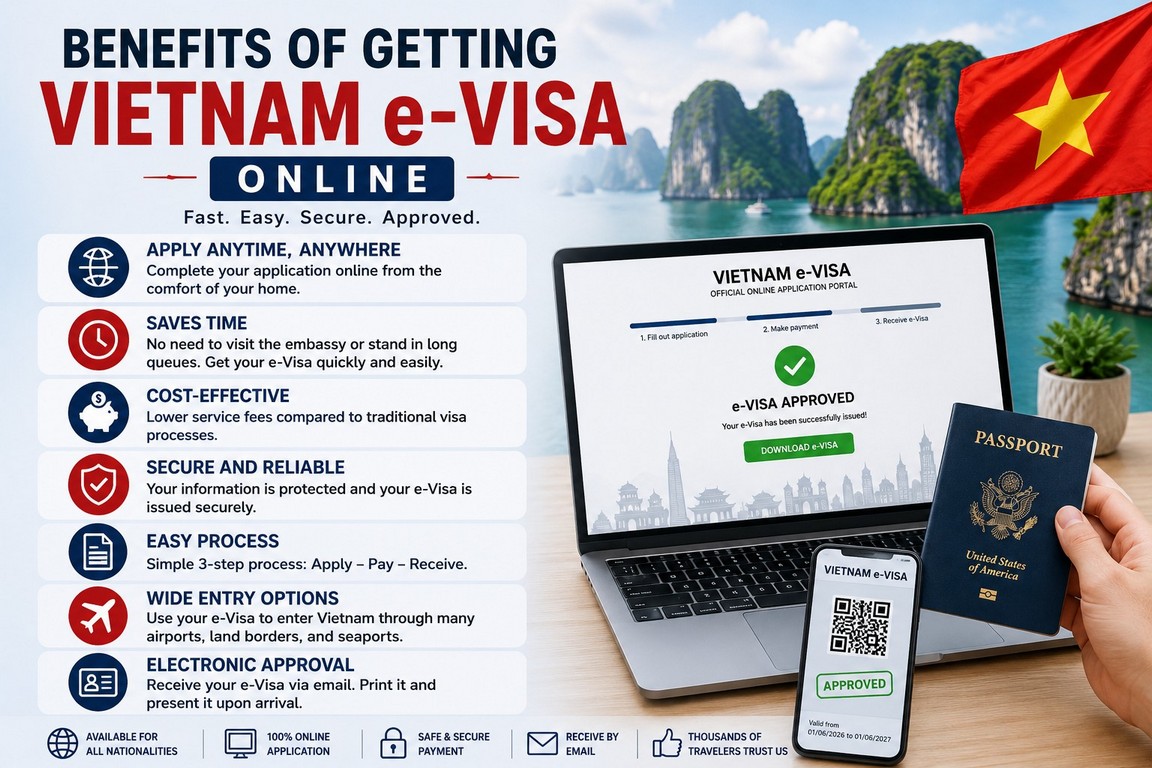
Vietnam Visa for US Citizens: Complete 2026 Guide
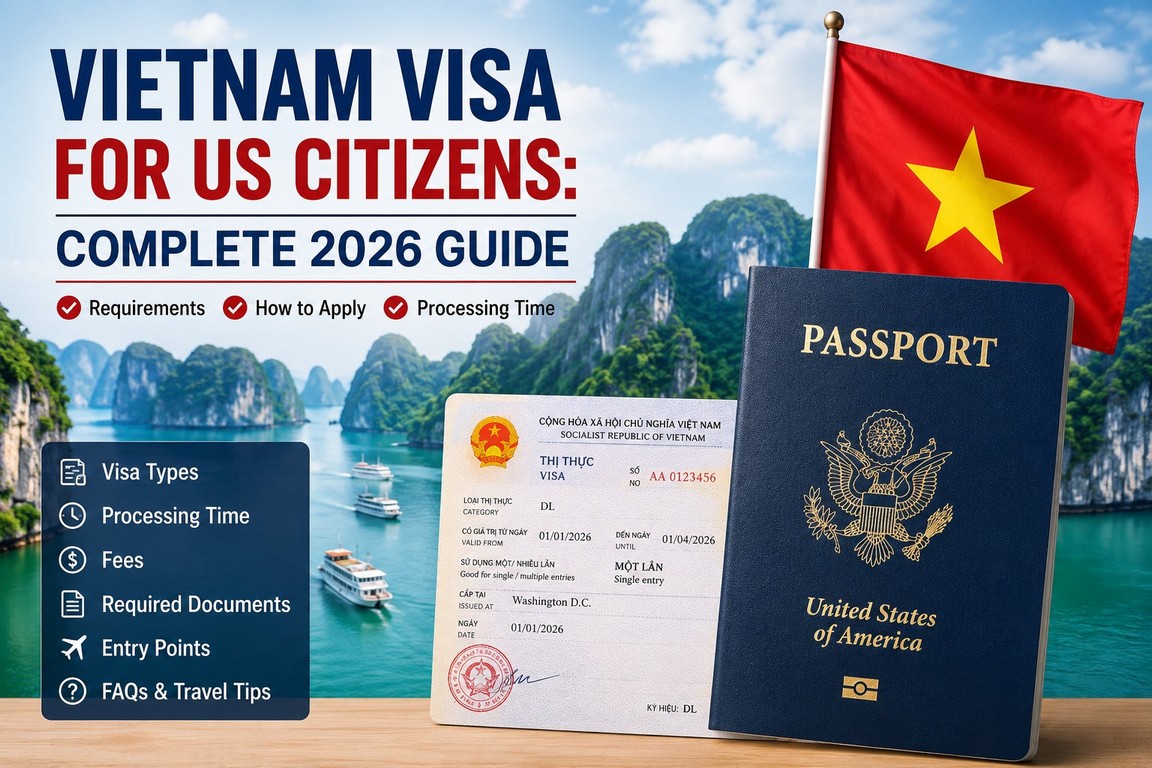
Vietnam Visa for US Citizens Complete Guide
Do US citizens need a visa for Vietnam?
Yes. American passport holders are not eligible for visa-free entry to Vietnam. As of 2025, US citizens must obtain either a Vietnam e-Visa (90 days, single or multiple entry) or a Visa on Arrival (VOA). The e-Visa is the easiest, most affordable option — available 100% online in 3-5 business days for approximately $25 USD.
Your Vietnam Dream Starts with the Right Visa
You’ve decided. Halong Bay. Hoi An’s lantern-lit streets. Hanoi’s chaotic, electric energy. Pho at 6am in a plastic chair on the sidewalk.
Vietnam is, without exaggeration, one of the most rewarding destinations on earth for American travelers. But before you book that flight, there’s one critical step that trips up thousands of first-timers every year: getting the right visa.
This guide gives you everything you need — not the outdated, copy-paste advice that litters the internet, but clear, current, and trustworthy information from people who understand how Vietnam’s immigration system actually works in 2025–2026.
Let’s get you to Vietnam.
What Are Your Visa Options as a US Citizen?
US citizens have three primary pathways to legally enter Vietnam:
| Visa Type | Max Stay | Cost | Processing Time | Best For |
|---|---|---|---|---|
| E-Visa (online) | 90 days | ~$25 USD | 3-5 business days | Most travelers |
| Visa on Arrival (VOA) | Up to 90 days | $25–$50+ stamping fee | Instant at airport | Those without time to apply online |
| Vietnam Embassy Visa | Up to 90 days | $50–$150+ | 5–10 business days | Those preferring in-person process |
Bottom line: The e-Visa is the gold standard for 99% of American tourists. It’s government-issued, affordable, and takes less than 5 minutes to apply.
Option 1: Vietnam E-Visa — The Best Choice for Americans
What Is the Vietnam E-Visa?
The Vietnam e-Visa (Electronic Visa) is an official, government-issued travel authorization you apply for entirely online through the Vietnam Immigration Department’s official website at evisa.gov.vn.
It replaced the old 30-day single-entry e-visa in 2023, when Vietnam upgraded the system to allow up to 90 days, single or multiple entry — a massive improvement that made it competitive with Thailand and other regional destinations.
E-Visa Key Details
- Maximum stay: 90 days per entry
- Entry type: Single or multiple entry
- Cost: Approximately $25 USD
- Processing time: 3 business days (some users report approval in 24 hours)
- Validity: The visa is valid for 90 days from the date of issue, not from your entry date — plan accordingly
- Eligible nationalities: Yes, US citizens are eligible
- Entry points: Over 13 international airports, 16 land borders, and 7 sea ports
How to Apply for a Vietnam E-Visa — Step-by-Step
Step 1: Go to the official government website
Only use: evisa.gov.vn. Dozens of third-party sites mimic this portal but charge 2–5x more. The official site charges $25.
Step 2: Select “Grant e-visa to foreigners”
Choose your nationality (United States), passport type, and intended entry/exit ports.
Step 3: Fill in your personal information
This includes: full legal name (exactly as on your passport), date of birth, passport number, expiry date, and travel purpose.
Step 4: Upload required documents
- A clear color scan of your passport data page
- A passport-style photo (white background, face clearly visible)
Step 5: Pay the $25 USD fee
Accepted payment: international credit/debit cards (Visa, Mastercard, JCB, AMEX).
Step 6: Wait and download your e-Visa
You’ll receive an email confirmation with a transaction code. Check status at the website. Upon approval, download your e-Visa PDF — print a physical copy and carry it on you.
Option 2: Visa on Arrival (VOA) — When and Why to Use It
What Is Visa on Arrival?
The Vietnam Visa on Arrival allows you to obtain your visa stamp at international airports in Vietnam (not land borders — that distinction matters). You apply for a Letter of Approval in advance through a third-party agency, then present it upon arrival to pay the stamping fee and receive your visa.
When VOA Makes Sense
VOA is genuinely useful in two scenarios:
- Your trip is within 3 days and you don’t have time to wait for e-Visa processing
- You’re flying into a major hub (Hanoi, Ho Chi Minh City, Da Nang, Nha Trang) and prefer the airport process
VOA Honest Assessment
VOA comes with a few friction points worth knowing:
- You must use a third-party agency (adds cost, usually $10–$20 for the approval letter)
- Stamping fee of $25 (single) or $50 (multiple entry) paid cash in USD or Vietnamese Dong upon arrival
- Long queues at VOA desks, especially at Tan Son Nhat Airport (Ho Chi Minh City)
- Some agencies are unreliable — research carefully
Our recommendation: Unless you’re in a time crunch, the e-Visa is cleaner, cheaper overall, and hassle-free. The VOA era is effectively over for most travelers.
Option 3: Visa Through the Vietnamese Embassy
Applying through the Vietnamese Embassy or Consulate in the US (Washington D.C., San Francisco, Houston, or New York) is the traditional route. It’s slower and more expensive, but useful if:
- You have a complex itinerary requiring special visa types
- You’re applying for a business visa
- You prefer a face-to-face process
Processing time: 5–10 business days
Cost: $50–$150+ depending on visa type and service speed
Required documents: Application form, passport photos, passport copy, return flight proof
For pure tourism purposes, this option is rarely the right choice in 2026.
Vietnam Visa Cost Breakdown for US Citizens
Understanding the true cost saves you from budget surprises:
| Item | E-Visa | VOA | Embassy Visa |
|---|---|---|---|
| Application fee | $25 | $10–$20 (agency) | $50–$150 |
| Stamping fee | None | $25–$50 | None |
| Third-party markup | None (if using official site) | Often added | Possible |
| Total estimate | ~$25 | $35–$70+ | $50–$150+ |
Vietnam Visa Processing Time for Americans
E-Visa: 3-5 business days (standard). Some applications are approved in 72 hours; a small percentage take up to 5 business days during peak holiday seasons (Tet, summer school holidays).
Practical advice: Apply at least 7–10 days before departure. This gives you a buffer if there’s a rejection or if you need to resubmit a document.
Can you expedite? A Vietnam Emergency Visa (also called an urgent visa, expedited visa, or last-minute visa) is a fast-track visa service designed for travelers who need to enter Vietnam on very short notice.
Vietnam Entry Requirements Beyond the Visa
Getting the visa is step one. Here’s what else you need at the border:
Passport Validity
Your US passport must be valid for at least 6 months beyond your entry date. This is non-negotiable. Vietnamese immigration will turn you away if your passport expires within 6 months of arrival.
Return or Onward Ticket
While not always enforced, airlines may ask for proof of onward travel before boarding. Having a return flight booked (even a refundable one) avoids issues at check-in.
Proof of Accommodation
Some immigration officers may request hotel booking confirmation for at least your first few nights. Keep a printed or digital copy accessible.
Proof of Sufficient Funds
No hard minimum is enforced, but having access to approximately $50–$100/day is a reasonable benchmark for showing you can support yourself financially.
Yellow Fever Vaccination
If you’re traveling from a country with risk of yellow fever transmission, you’ll need a vaccination certificate. This doesn’t apply to travelers flying directly from the United States.
How Long Can US Citizens Stay in Vietnam?
With an e-Visa, you can stay up to 90 days per entry.
With a multiple-entry e-Visa, you can leave and re-enter Vietnam within the 90-day validity period of the visa.
Important distinction: The 90-day visa validity starts from the date of issue, not the date of first entry. If your visa is issued on June 1 and you enter on June 15, your visa still expires on August 30 — not September 14.
Options for extending your stay beyond 90 days:
- Exit and re-apply: Leave Vietnam (e.g., take a short trip to Cambodia, Thailand, or Laos), apply for a new e-Visa, and re-enter. No formal “visa run” restriction exists in Vietnamese law as of 2025, but frequent short exits may attract scrutiny.
- Apply for a longer-term visa: Business or investor visas can allow 1–5 year stays with appropriate documentation.
- Temporary residence: Long-term options exist for those with work permits, investments, or family ties.
Note: Vietnam eliminated the 15-day visa exemption for US citizens that existed for a brief period. As of 2025, US citizens require a visa for all visits.
Common Mistakes US Citizens Make with Vietnam Visas
These are the errors our consultants see most often — and every one is completely avoidable.
Mistake #1: Confusing Visa Validity with Length of Stay
Your 90-day visa is valid for 90 days from the issue date. If you delay your trip, the clock has already started. Apply close to your travel date.
Mistake #2: Not Printing the E-Visa
A digital copy on your phone is not sufficient. Vietnamese immigration officers at many entry points require a printed physical copy. Print it before you travel.
Mistake #3: Wrong Name Capitalization or Spelling
Your name on the e-Visa application must exactly match your passport. Middle names matter. Typos trigger rejection or, worse, denial of entry.
Mistake #4: Arriving at a Non-Approved Entry Point
Your e-Visa specifies entry and exit points. Arriving at a border crossing not listed on your visa is grounds for denial. Double-check your entry point when applying.
Mistake #5: Assuming a Visa-Run Is Guaranteed
While visa runs are common practice, Vietnam immigration does have discretion to deny re-entry if they suspect you’re attempting to live in Vietnam on tourist visas indefinitely.
Mistake #6: Applying Too Early
If you apply 3 months before your trip, your visa may expire before you even travel. Apply 7–14 days before your departure date.
Travel Entry Tips: What to Expect Arriving in Vietnam
Knowing what happens at the border removes a lot of first-timer anxiety.
At the Airport (Ho Chi Minh City / Hanoi / Da Nang)
- Immigration card: Some flights still provide a paper arrival card. Fill it out on the plane.
- Queue: Follow signs for “Visa on Arrival” (if applicable) or “All Passports.”
- Biometrics: Vietnam now takes fingerprints and a photo at immigration — this is routine.
- What to hand over: Passport + printed e-Visa + arrival card (if required) + proof of accommodation if asked.
- Wait: Processing per person takes 1–3 minutes. Queues at peak times (early morning international arrivals) can run 20–40 minutes.
Customs
Travelers can bring in up to $5,000 USD (or equivalent) in cash without declaration. Above this, you must declare it. Duty-free allowances include 1.5L of spirits and 200 cigarettes.
SIM Cards and Local Currency
Get a local SIM card immediately after clearing customs — airport kiosks are reliable. Viettel, Vinaphone, and Mobifone all offer tourist SIMs for $3–$7 USD with solid 4G/5G coverage. Exchange some cash (USD or withdraw VND from ATMs) as many vendors, markets, and local restaurants operate cash-only.
Frequently Asked Questions (FAQ)
1. Do US citizens need a visa to visit Vietnam in 2026?
Yes. US passport holders are not eligible for visa-free entry to Vietnam. The easiest option is the Vietnam e-Visa, which costs $25 USD and takes 3-5 business days to process online.
2. How long can a US citizen stay in Vietnam on a tourist visa?
With the current Vietnam e-Visa, US citizens can stay up to 90 days per entry. The visa is valid for 90 days from the date of issue, not from the date of arrival.
3. How long does it take to get a Vietnam visa for US citizens?
The e-Visa typically processes in 3-5 business days. In some cases, approval arrives within 24 hours. During peak travel seasons (Tet holiday, summer), allow up to 5–7 business days.
4. Can I get a Vietnam visa on arrival as a US citizen?
Yes. Visa on Arrival is available at Vietnam’s major international airports (not land borders). However, you must pre-arrange a Letter of Approval through a third-party agency, pay a stamping fee at the airport, and face potentially long queues. The e-Visa is generally recommended over VOA.
5. Can I extend my Vietnam visa once I’m there?
Visa extensions through Vietnamese immigration offices are theoretically possible but have become increasingly difficult for tourist visas. Most long-term travelers instead exit Vietnam briefly and apply for a new e-Visa.
6. Is the Vietnam e-Visa available for multiple entries?
Yes. When applying for the Vietnam e-Visa, you can choose between single-entry and multiple-entry options. Both allow up to 90 days per entry, and the multiple-entry visa lets you exit and re-enter Vietnam within the visa’s validity period.
7. What documents do I need to apply for a Vietnam e-Visa?
You need: a valid US passport (valid for 6+ months beyond entry), a digital scan of your passport bio page, a recent passport-style photo, your travel dates, and a credit or debit card for the $25 fee.
8. Can my Vietnam e-Visa be rejected?
Yes, though rejections are uncommon for US citizens applying correctly. Common reasons for rejection: mismatched name/passport details, poor-quality document scans, invalid entry ports, or incomplete applications.
Vietnam Visa Checklist for US Citizens
Before you apply, make sure you have:
- Valid US passport (6+ months validity from travel date)
- High-resolution scan of passport bio page
- Recent passport-style photo (white background)
- Confirmed travel dates
- Entry and exit ports decided
- International credit or debit card (Visa/Mastercard/Amex)
- Email address to receive visa confirmation
After approval:
- Downloaded e-Visa PDF
- Printed physical copy of e-Visa
- Booked accommodation for first few nights
- Purchased travel insurance (highly recommended)
Conclusion: Your Vietnam Adventure Is One Visa Away
Vietnam welcomes over 12 million international visitors annually — and the number of Americans making the journey grows every year. It’s not hard to see why. From the limestone karsts of Halong Bay to the coffee-shop culture of Hanoi’s Old Quarter, this country rewards curious, open-minded travelers at every turn.
Getting your Vietnam visa as a US citizen is genuinely simple when you follow the right steps:
- Apply on the official government portal
- Pay the $25 fee
- Wait 3-5 business days
- Print your e-Visa
- Pack your bags
Don’t let the visa process be the thing that delays your trip. Thousands of Americans navigate it smoothly every week.
Internal Link Suggestions
- Vietnam Travel Guide for First-Timers
- Best Time to Visit Vietnam: Month-by-Month Breakdown
- Vietnam Itinerary: 2 Weeks from Hanoi to Ho Chi Minh City
- Vietnam Travel Budget: How Much Does a Trip Actually Cost?
External Link Suggestions (Authority Sources)
- Vietnam Immigration Department — Official E-Visa Portal
- US Embassy in Hanoi — Vietnam Travel Information
- US Department of State — Vietnam Country Information
Last updated: June 2026 | Information verified against the Vietnam Immigration Department official portal and US Embassy Hanoi advisories.