


Vietnam visa for citizens of United States
Documents required Vietnam visa for passport holders of United States
What Do U.S. Citizens Need to Apply for a Vietnam Visa?
To obtain a Vietnam e-Visa in 2026, U.S. citizens have to prepare the follows:
- A valid U.S. passport with at least 6 months validity
- A clear digital scan of the passport bio page
- A recent passport-style photo with white background
- Confirmed travel dates and entry/exit ports
- An international credit or debit card to pay the government processing fee (USD 25 for a single-entry visa or USD 50 for a multiple-entry visa).
The application process is entirely online. No interview, invitation letter, supporting documents, or embassy visit is required.
The Key to a Smooth Application: Getting the Requirements Right
The Vietnam e-Visa process is truly simple —but only when your documents meet all official requirements.
Each year, many U.S. travelers experience delays or visa refusals due to simple documentation errors rather than complicated immigration issues. Common mistakes include uploading a photo with an incorrect background, submitting a blurry passport scan, or entering personal information that does not exactly match the passport details are among the leading causes of application rejections.
To help you avoid unnecessary delays, this guide explains every Vietnam e-Visa requirement for U.S. citizens, including the required documents, exact specifications, and the most common mistakes applicants make.
Vietnam e-Visa Requirements for U.S. Citizens: Essential Checklist
Gather all required documents before accessing the e-Visa application portal:
| Requirement | Specification | Status |
|---|---|---|
| US Passport | Valid 6+ months beyond entry date | Required |
| Passport scan | High-res color scan, all 4 corners visible | Required |
| Passport photo | White background, recent, front-facing | Required |
| Travel dates | Specific entry and exit dates | Required |
| Entry/exit port | Selected from approved list | Required |
| Payment method | Visa, Mastercard, AMEX, JCB | Required |
| Email address | For confirmation and download | Required |
| Return/onward ticket | Not required to apply, but useful on arrival | Recommended |
| Hotel booking | Not required to apply, sometimes checked on arrival | Recommended |
| Travel insurance | Not required, but strongly advised | Recommended |
Requirement #1: U.S. Passport Validity
The 6-Month Rule — Non-Negotiable
Your US passport must be valid for at least 6 months beyond your planned date of entry into Vietnam. This is a firm requirement enforced at both the airline check-in counter and Vietnamese immigration.
Example: If you’re entering Vietnam on October 1, 2025, your passport must not expire before April 1, 2026.
A common mistake among American travelers is assuming that a passport with a few months of validity remaining is sufficient. Airlines can deny boarding before you even reach Vietnam if your passport doesn’t meet this requirement.
What to Do If Your Passport Is Expiring Soon
If your passport expires within 6 months of your planned trip:
- Renew immediately — US passport renewal currently takes 6–8 weeks for routine processing, 2–3 weeks for expedited service
- Apply for expedited renewal at a US passport agency if your trip is within 4 weeks
- Do not apply for your Vietnam visa until you have the renewed passport in hand — your visa must match your current passport number
Insider tip:US State Department’s passport appointment system is in high demand. Book your appointment as soon as you know you’re traveling. Do not wait.
Passport Condition Requirements
Your passport must also be:
- Undamaged — Torn pages, water damage, or a separated cover can trigger denial at immigration
- Machine-readable — The two lines of characters at the bottom of your bio page must be legible
- Not reported lost or stolen — If a previous passport was reported lost and later found, do not use it; use your current valid passport instead
Requirement #2: Passport Bio Page Scan
What Is the Passport Bio Page?
The passport bio page shows your photo and personal details, including your full name, date of birth, passport number, issue date, and expiry date.
You must scan this page and upload it as part of your Vietnam e-Visa application.
Passport Scan Requirements
Vietnamese immigration has specific technical requirements for uploaded documents. Scans that are blurry, cropped, incomplete, or otherwise non-compliant are among the most common reasons e-Visa applications are delayed or rejected.
| Specification | Requirement |
|---|---|
| Format | JPEG or JPG |
| File size | Under 2MB |
| Color | Full color (not black and white) |
| Resolution | Minimum 300 DPI recommended |
| All 4 corners | Must be visible — no cropping |
| No glare | Scan must be flat, no flash reflection |
| Text legibility | All printed text must be clearly readable |
| Background | No shadows, no colored backgrounds |
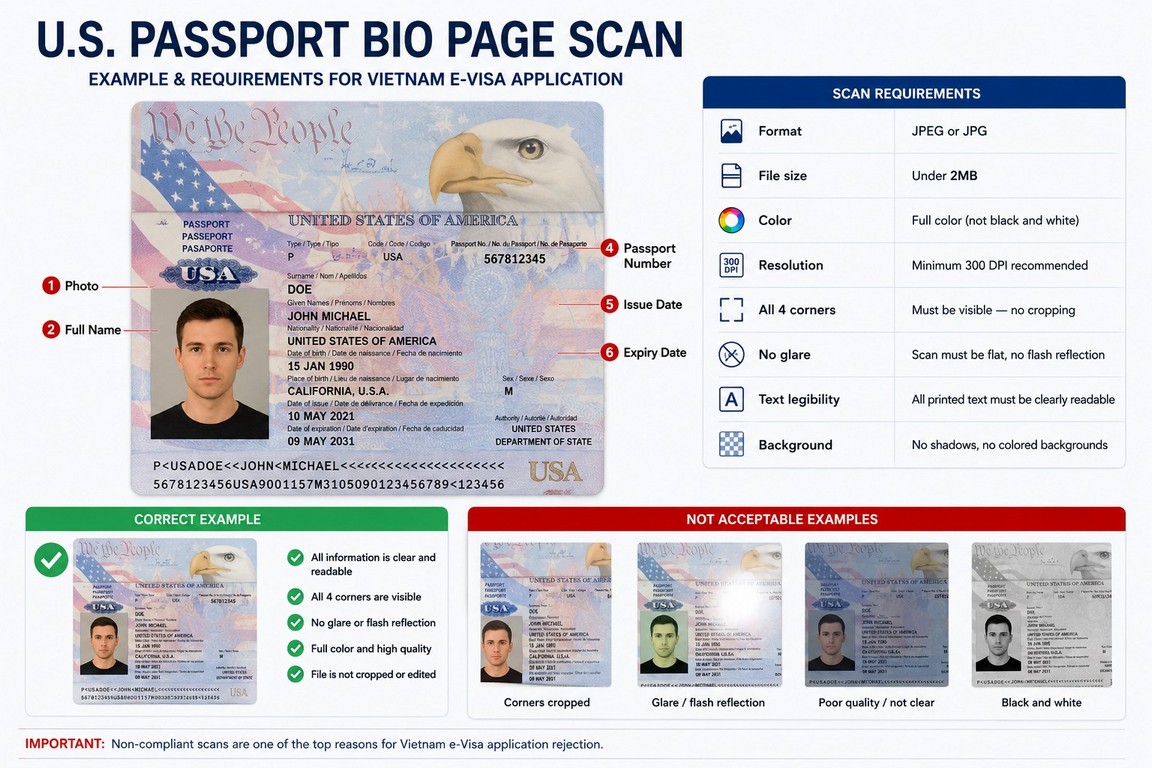
Example & Requirements for Vietnam e-Visa application
Best Practice: How to Get a Good Scan
Using a scanner: Place the passport flat, face-down. Scan at 300+ DPI in color. Save as JPEG.
Using a smartphone: Use a document scanning app (Adobe Scan, Microsoft Lens, or the iPhone’s built-in document scanner in Notes). Shoot in a well-lit room with no shadows across the page. Enable auto-edge detection. Save as JPEG.
What to avoid:
- Taking a photo of your passport at an angle, which can distort the image and lead to rejection
- Using flash, as glare may obscure the machine-readable zone at the bottom of the page
- Capturing the image in poor or uneven lighting, making important details difficult to read
- Uploading the file as a PDF instead of a JPEG, as the e-Visa portal only accepts JPEG format
Requirement #3: Passport Photo Specifications
Vietnam E-Visa Photo Requirements
The passport photo uploaded to your e-Visa application must meet these specifications.
| Specification | Requirement |
|---|---|
| Background color | Pure white only |
| Size | 4cm × 6cm (or equivalent ratio) |
| File format | JPEG |
| File size | Under 2MB |
| Photo recency | Taken within the last 6 months |
| Face position | Front-facing, centered |
| Face coverage | 70–80% of the frame |
| Expression | Neutral expression, mouth closed |
| Eyes | Open, clearly visible, not obscured |
| Glasses | Not recommended (can cause glare issues) |
| Head coverings | Not permitted unless for religious reasons |
| Image quality | No pixelation, no blurriness |
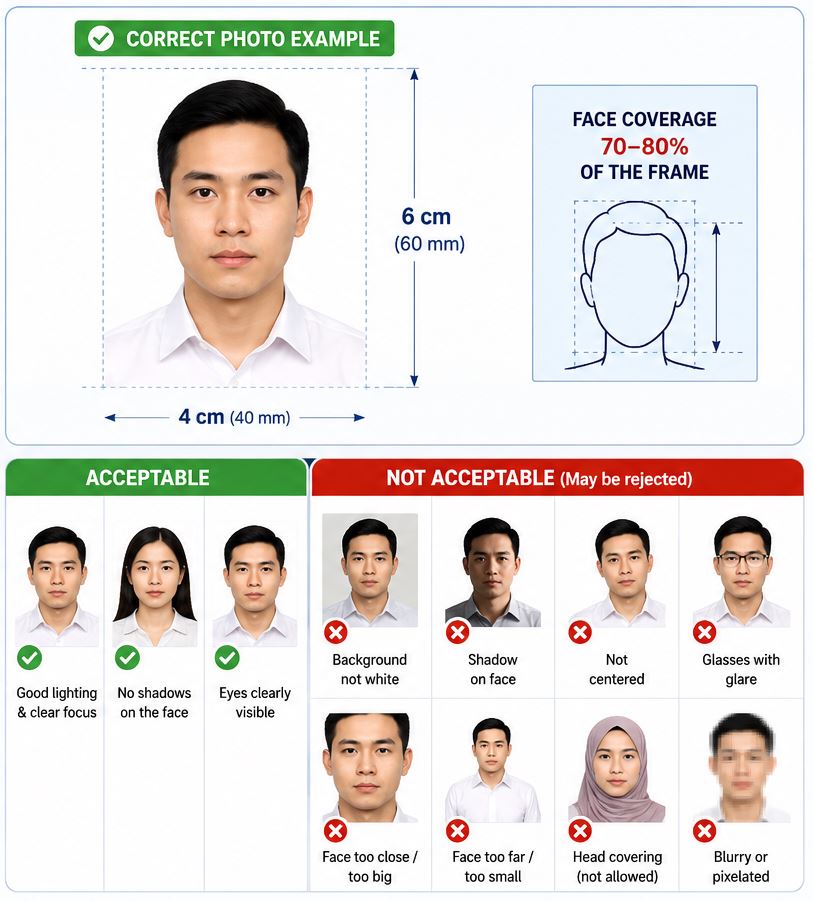
Vietnam E-Visa Photo Requirements
Common Photo Mistakes That Cause Rejection
- Incorrect background color — The background must be plain white. Off-white, cream, light gray, patterned backgrounds, or backgrounds with visible shadows may result in rejection.
- Improper face size — Your face should occupy approximately 70–80% of the photo. Images taken from too far away or cropped too closely around the face may not be accepted.
- Outdated photo — The photo should accurately reflect your current appearance. If your appearance has changed significantly, use a recent photo rather than one taken several years ago.
- Reused document photo — Avoid uploading a cropped photo from a previous visa, ID card, passport, or driver’s license. Take a new photo that meets the current e-Visa requirements.
How to Capture a Valid E-Visa Photo from Home
You don’t need a professional photographer. A decent smartphone and some preparation work fine:
- Stand in front of a white wall or hang a white sheet behind you
- Face a window for natural, even lighting (don’t use flash)
- Look directly at the camera lens, not the screen
- Keep a neutral expression — slight natural smile is acceptable
- Check the background for shadows or colored objects in frame
- Take 5–6 shots and choose the sharpest, most evenly lit one
- Crop to the correct ratio (4×6 or 2×3) using your phone’s editor or a free tool like remove.bg for background cleanup
Requirement #4: Travel Information — Date and Port
Why Choosing the Correct Entry and Exit Ports Is Important
A Vietnam e-Visa is issued based on the entry and exit ports you provide in your application. It is not a general travel authorization valid at every border crossing, airport, or seaport. Arriving at a port that is not permitted under your e-Visa may lead to delays or denial of entry.
When completing your application, you will need to specify:
- Your intended entry port — the airport, land border, or seaport where you will first enter Vietnam
- Your intended exit port — the airport, land border, or seaport where you plan to leave Vietnam
- Selecting the correct ports helps ensure a smooth arrival and departure process.
Where U.S. Citizens Can Enter Vietnam with an E-Visa
Vietnam has expanded its list of approved e-Visa entry points significantly in 2023–2025. Current approved international airports include:
Major International Airports:
- Noi Bai International Airport (Hanoi)
- Tan Son Nhat International Airport (Ho Chi Minh City)
- Da Nang International Airport
- Cam Ranh International Airport (Nha Trang / Khanh Hoa)
- Phu Quoc International Airport
- Cat Bi International Airport (Hai Phong)
- Can Tho International Airport (Can Tho)
- Lien Khuong International Airport (Da Lat)
- Phu Bai International Airport (Hue)
- Phu Cat Airport (Binh Dinh)
- Van Don International Airport (Quang Ninh)
- Tho Xuan Airport (Thanh Hoa)
- Dong Hoi Airport (Quang Binh)
Major Land Border Crossings:
- Mong Cai (Quang Ninh) — Vietnam/China border
- Huu Nghi (Lang Son) — Vietnam/China border
- Lao Cai — Vietnam/China border
- Tay Trang (Dien Bien) — Vietnam/Laos border
- Na Meo (Thanh Hoa) — Vietnam/Laos border
- Lao Bao (Quang Tri) — Vietnam/Laos border
- La Lay (Quang Tri) — Vietnam/Laos border
- Nam Can (Nghe An) — Vietnam/Laos border
- Cau Treo (Ha Tinh) — Vietnam/Laos border
- Cha Lo (Quang Binh) — Vietnam/Laos border
- Bo Y (Kon Tum) — Vietnam/Laos border
- Moc Bai (Tay Ninh) — Vietnam/Cambodia border
- Xa Mat (Tay Ninh) — Vietnam/Cambodia border
- Moc Bai (Tay Ninh Province) — Vietnam/Cambodia border
- Song Tien (An Giang) — Vietnam/Cambodia border
- Tinh Bien (An Giang) — Vietnam/Cambodia border
- Ha Tien (Kien Giang) — Vietnam/Cambodia border
Sea Ports:
- Hon Gai Port (Quang Ninh)
- Cam Pha Port (Quang Ninh)
- Hai Phong Port (Hai Phong)
- Nghi Son Port (Thanh Hoa)
- Vung Ang Port (Ha Tinh)
- Chan May Port (Thua Thien Hue)
- Da Nang Port
- Nha Trang Port (Khanh Hoa)
- Quy Nhon Port (Binh Dinh)
- Dung Quat Port (Quang Ngai)
- Vung Tau Port
- Saigon Port (Ho Chi Minh City)
- Duong Dong Port (Phu Quoc Island)
Requirement #5: Financial and Payment
Application Fee
- Payment method: International credit or debit card — Visa, Mastercard, AMEX, JCB accepted
- Non-refundable: The fee is not refunded if your application is rejected or if you cancel your trip
Proof of Sufficient Funds for Entry into Vietnam
No specific minimum financial requirement for visitors has been public yet, Immigration officers may ask travelers to demonstrate that they have adequate funds to cover their stay in the country. While such checks are uncommon for U.S. citizens, they remain within the discretion of immigration authorities.
As a general guideline, travelers should have access to approximately USD 50–100 per day of their planned stay, whether through cash, credit cards, debit cards, or bank accounts.
In most cases, a confirmed return or onward ticket and verified accommodation bookings are sufficient to demonstrate that you are financially prepared for your trip.
Requirement #6: Additional Entry At the border
Receiving your visa is the first step; complying with entry requirements is what gets you through border control.
Return or Onward Ticket
Vietnamese immigration does not formally require proof of onward travel for visa holders. However:
- Airlines may ask for proof before allowing you to board your flight to Vietnam.
- Immigration officers may request it in rare cases if your circumstances seem unusual.
Having a booked return flight (even a flexible or refundable one) removes this variable entirely.
Hotel Booking or Accommodation Address
You may be asked to provide your accommodation address for your first night in Vietnam. This can be:
- A hotel booking confirmation.
- An Airbnb or short-term rental address.
- A friend or family member’s address if you’re staying with someone.
You don’t need to have your entire trip planned — just your first destination.
Travel Insurance
Travel insurance is not a legal requirement to enter Vietnam, but it is one of the most important things any traveler to Southeast Asia should carry.
Medical care in Vietnam ranges from good (major cities like Hanoi and Ho Chi Minh City have international hospitals) to very basic (rural and remote areas). Emergency medical evacuation from Vietnam can cost $30,000–$100,000+ USD without insurance.
Recommended minimum coverage:
- Medical expenses: $100,000+
- Emergency evacuation: $250,000+
- Trip cancellation: Full trip cost
- Lost baggage: $1,500+
Requirement #7: Health-Related Entry
COVID-19 Status (2025)
Vietnam has removed all COVID-19-related entry restrictions. Travelers are no longer required to provide proof of vaccination, present a negative test result, or complete any COVID-19 health declaration forms.
Yellow Fever Vaccination
Travelers arriving from countries with a risk of yellow fever transmission—primarily certain countries in sub-Saharan Africa and South America—must carry a valid International Certificate of Vaccination or Prophylaxis (ICVP), commonly known as a “Yellow Card.”
For US citizens traveling directly from the United States, a yellow fever vaccination certificate is not required.
Recommended Vaccinations
Vietnam does not require any vaccinations for entry beyond the yellow fever rule described above.
Effective July 1, 2026, travelers must complete a health declaration within 7 days prior to their date of entry, departure, or transit.
Health declarations may be completed through either:
- An online health declaration system; or
- A paper declaration form available in both Vietnamese and English.
Special Cases: Additional Requirements for Certain Travelers
Minors Traveling to Vietnam
Children under 18 must have:
- Their own valid US passport
- Their own Vietnam e-Visa application (submitted separately)
- All standard supporting documents required for the e-Visa process
Children traveling with only one parent or without either parent may also need:
- A notarized letter of consent from the non-traveling parent(s)
- Custody or guardianship documents, if applicable
- Additional paperwork required by the airline
Requirements for minors vary by airline, so check directly with your carrier before departure.
US Military Personnel
Active-duty US military personnel traveling to Vietnam on official government orders may be subject to separate entry procedures. However, military personnel visiting Vietnam for personal travel purposes must generally meet the same entry requirements as other US citizens, including obtaining a valid visa when required.
What Happens If You Don’t Meet the Requirements? Rejection Scenarios
Here are the documented reasons the Vietnam e-Visa system rejects US applications:
Common Reasons for e-Visa Application Rejection
| Rejection Reason | Prevention |
|---|---|
| Passport validity under 6 months | Renew passport before applying |
| Name mismatch with passport | Copy name exactly — every letter, space, and middle name |
| Blurry or low-quality passport scan | Rescan with good lighting and 300+ DPI |
| Wrong photo background (not white) | Retake photo against white background |
| Expired or low-quality photo | Use a photo taken within the past 6 months |
| Incomplete application fields | Review every field before submitting |
| Invalid entry/exit port selected | Cross-check against approved entry point list |
| Payment card declined | Try a Visa or Mastercard credit card |
Border Entry Denials
Receiving a visa approval does not guarantee admission into Vietnam. Immigration officers retain the authority to refuse entry upon arrival if a traveler does not meet entry requirements. While such cases are uncommon for US citizens, they can occur under certain circumstances, including:
- Expired visa — Attempting to enter after the visa’s validity period has ended. Remember that visa validity begins on the approved start date shown on the visa, not on the date you arrive.
- Previous immigration violations — A history of overstaying in Vietnam or other countries may result in additional scrutiny or denial of entry.
- Inconsistent travel information — Significant discrepancies between your visa application, travel plans, accommodation details, or stated purpose of visit may raise concerns during inspection.
- Public health requirements — During periods of heightened health risk or disease outbreaks, Vietnam may temporarily reinstate health screening measures, declarations, or other entry requirements.
To avoid problems at the border, ensure that your visa details, travel itinerary, passport information, and supporting documents are accurate and consistent before departure.
Vietnam Visa Requirements: Before vs. After Your Application
Many travelers confuse “what I need to apply” with “what I need to bring to Vietnam”
What You Need to Apply (Online)
- Valid US passport
- Passport bio page scan (JPEG, under 2MB)
- Passport-style photo (white background, JPEG)
- Entry/exit ports and travel dates
- Credit or debit card ($25 USD)
- Email address
What You Need to Bring to Vietnam (Physical)
- Original US passport (valid)
- Printed copy of your approved e-Visa — this is critical; digital only is often insufficient
- Return or onward flight ticket (for airline check-in and potential immigration query)
- Hotel booking confirmation (first night minimum)
- Sufficient funds (cash USD and/or accessible bank account)
- Travel insurance documentation
- Yellow fever certificate (only if traveling from an endemic country)
Frequently Asked Questions
1. What documents do I need for a Vietnam visa as a US citizen?
For the Vietnam e-Visa, you need: a valid US passport (6+ months beyond entry date), a color scan of your passport bio page, a white-background passport photo, your travel dates, entry/exit ports, and a credit or debit card for the $25 fee.
2. Does my passport need to be valid for 6 months to enter Vietnam?
Yes. Vietnam enforces the 6-month passport validity rule. Your passport must not expire within 6 months of your entry date. Airlines also enforce this at check-in.
3. What are the Vietnam e-Visa photo requirements for Americans?
Your photo must be on a pure white background, taken within the last 6 months, front-facing with neutral expression, with your face filling 70–80% of the frame. Save as JPEG under 2MB. No glasses, no head coverings (unless religious), no shadows.
4. Do I need to show proof of onward travel to enter Vietnam?
Not legally required for e-Visa holders, but airlines may request it before boarding. A booked return flight or onward ticket eliminates any potential issue at check-in or immigration.
5. Is travel insurance required to enter Vietnam?
No. Travel insurance is not a legal entry requirement for Vietnam. However, it is strongly recommended — emergency medical evacuation from Vietnam can cost tens of thousands of dollars without coverage.
6. Can I use a black-and-white scan of my passport for the Vietnam e-Visa?
No. The Vietnam e-Visa application requires a full-color scan of your passport bio page. Black-and-white scans will cause your application to be rejected.
7. What is the minimum passport validity for Vietnam?
Your passport must be valid for at least 6 months beyond your planned date of entry into Vietnam. This is a hard requirement — there are no exceptions.
8. Do children need their own Vietnam e-Visa?
Yes. Every traveler, including infants and children, must have their own individual e-Visa. Children cannot be included on a parent’s visa or passport.
9. What if my name on the Vietnam e-Visa application doesn’t match my passport?
This is one of the most common causes of visa rejection and potential denial of entry. Your name must be entered exactly as it appears in your passport — including middle names, hyphens, and capitalization. Contact Vietnamese immigration immediately if you notice an error after submission.
10. Do I need to show a hotel reservation when applying for a Vietnam e-Visa?
No. A hotel reservation is not required during the e-Visa application process. You only need to provide your intended entry and exit ports and travel dates. A hotel booking may be requested by immigration officers on arrival.
Final Checklist Before You Fly to Vietnam
Use this checklist 7–14 days before your departure:
Passport & Visa
- US passport valid for 6+ months beyond entry date
- The print-out of Vietnam e-Visa approved and downloaded as PDF in your handheld appliances.
- Passport photo copies (bring 2–4 extra passport photos for any unexpected requirements)
Travel Documents
- Return or onward flight ticket (digital or printed)
- Hotel/accommodation booking confirmation (first 1–2 nights minimum)
- Travel insurance policy document (digital or printed)
- Emergency contact list (US Embassy Hanoi: +84-24-3850-5000)
Financial Preparation
- Notify your US bank of international travel to prevent card blocks
- Carry $100–$200 USD cash for arrival (SIM card, taxi, early expenses)
- Know your bank’s international ATM withdrawal limits
Health Documentation
- Routine vaccinations up to date (per CDC recommendations)
- Yellow fever certificate (only if arriving from an endemic country)
- Prescription medication in original packaging with documentation
Start Your Vietnam Visa Application Today
Have a specific question about your situation — dual citizenship, traveling with a minor, unusual passport type, or a previous rejection? Leave it in the comments or contact our visa consultants directly.
→ Vietnam Visa for US Citizens: Complete 2026 Guide
→ How to Apply for a Vietnam E-Visa Step by Step
→ Vietnam Visa Cost: Full Breakdown for American Travelers
→ Vietnam Entry Requirements: What to Expect at the Border
→ Vietnam Travel Guide for First-Time American Visitors
→ Best Time to Visit Vietnam: Month-by-Month Guide
Last updated: May 2026 | Verified against Vietnam Immigration Department official portal, US Embassy Hanoi travel advisories, and US Department of State Vietnam country information page.